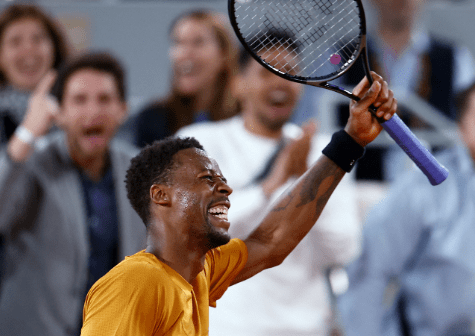

Gael Monfils is not going to win Roland Garros. He isn’t going to win any major tournament in the remainder of his career. Is that harsh? I don’t think so. Monfils is past his prime. He is in a different stage of his life and his tennis journey. He has played in major semifinals and competed for high stakes. Now, after injuries, marriage, and fatherhood have intervened, and as accumulated wear and tear takes its toll on his body, Monfils is not immersed in the competitive cauldron which consumed him in years when he had a real chance to lift a huge trophy.
He came close to beating Roger Federer in the 2008 Roland Garros semifinals — never likely to win, but he almost forced a fifth set in which the crowd would have been fully on his side. He had Federer on the ropes in the 2014 U.S. Open quarterfinals, only to lose after having match points. Who knows? If he had played Marin Cilic, maybe Monfils might have had the unlikely path to a major, not Cilic.
In 2016, Monfils played the best major tournament of his career at the U.S. Open, steamrolling through five rounds before running into Novak Djokovic in the semifinals.
Monfils has lived the life of a tennis player for whom anything and everything was once possible.
That life no longer exists.
In 2023, many years after those pursuits of glory, Monfils has in many ways triumphed, but not in the sense of lifting a trophy. He has been broken by tennis and reduced to the misery of losing — as most athletes are — but that brokenness, the feeling which overwhelms the athlete’s mind after a parade of bad results and a lack of reward for all the hard work, never stopped Gael Monfils from loving the sport itself.
Tuesday night at Roland Garros, on Court Philippe Chatrier, Monfils wasn’t playing to win a major championship. He wasn’t playing for rankings points or better positioning for Wimbledon or the summer hardcourt season. He wasn’t playing to test out some tweaks in his game which could put him on par with Holger Rune, the top-10 player he’ll meet in the second round.
Gael Monfils was competing for himself, for the love of the game, and for a French crowd which loved him back.
This was a story of love. This match against Sebastian Baez was one long love letter to tennis, to France, to wife Elina Svitolina, and to his new daughter Skai, born last October.
This match was classic Monfils in all the ways we have come to know, and love, and accept, and endure. For better or worse, for rich or poor, Monfils took a worldwide audience and the Chatrier crowd through the very familiar roller-coaster ride of excellence, absurdity, awesome athleticism, human limitations, power, frailty, and all the other contradictory and coexisting elements of the quintessential Gael experience.
Yet, while this match was very familiar in its ups and downs and wild swings, what was different was that the pressure of the moment didn’t weigh down anyone. If this was a match in which Monfils had a real chance to make the semifinals or final — if this was a match in which Monfils was viewed as a dangerous floater in the draw and had a chance to catapult his career to a higher level — the burden associated with a potential defeat would have been so much greater.
The match was not played with that albatross, that looming thought, lurking in Monfils’ mind or in the hearts of the audience. Everyone was able to watch, enjoy and accept this commonly crazy match (for that’s what Monfils matches are) in a spirit of fun, joy and pleasure.
That’s how Monfils treated it, at least.
His facial expressions were even more goofy and uninhibited than they usually are. He hiked up his shorts. He had long discussions with his box on the court. Gael was letting loose, and he didn’t care about the consequences or the optics … and everyone watching clearly understood. This was not weird or bizarre behavior. It was just a guy having fun and being himself, knowing he was accepted and knowing that the result of the match meant far less than the joie de vivre of being alive, in the arena, having fun.
This wasn’t Monfils’ last match, and it probably won’t be Monfils’ last Roland Garros. Yet, for a man who has played in major semifinals, Davis Cup Finals, and Masters 1000 finals, this late-career match might be remembered as the most special moment of Gael Monfils’ career. It maximized joy, it magnified love, and it came straight from the heart.
In the end, that’s what Gael Monfils’ career has meant — not only to France and to tennis fans, but to the person whose opinion matters the most in this case: Gael Monfils himself.
 Tennis with an Accent