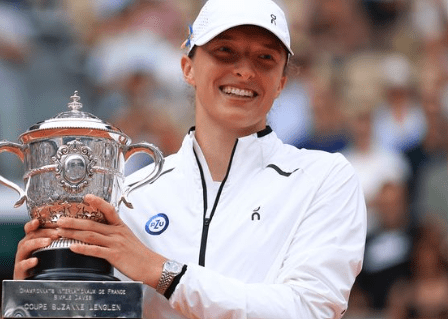

The conditions at Roland Garros — or should we say, “Poland Garros” — were not wet or damp on Saturday. Moreover, even if they were, the roof over Court Philippe Chatrier would have ensured that the red clay of the French Open would have remained dry. Literally, these clay courts of Paris were not muddy or especially slow over the past fortnight. Those kinds of conditions belonged to Rome, whose courts have no roofs and whose weather was relentlessly rainy for the two weeks which encompassed that tournament at the Foro Italico.
Iga Swiatek did not literally win in the mud in Paris, but she figuratively did.
For purposes of our discussion, think of a basketball team which has multiple star players and is luminously talented. That team loves to play at a fast pace and score tons of points. It’s an offense-first team which frequently overwhelms opponents and delivers an early-stage knockout punch. It comes at an opponent in waves and dominates with firepower, skill, and pure athletic prowess.
That’s Iga Swiatek on most days. The 22-year-old hits with pace, bite and placement, generating spin, movement and angle her opponents can’t match. If Swiatek is in full flight, hitting a big ball and not offering many mistakes, the match is usually over very quickly. When everything clicks, an elite talent such as Swiatek will dominate from start to finish. The scoreline will be very lopsided. The time of match will clock in at under 100 minutes, often less than that.
However, what happens when the shots aren’t clicking? What happens when the mistakes are flowing off the racquet? What happens when the rhythm vanishes and the precision recedes? What then? What happens when the weight of the occasion falls heavily on the mind, and the opponent (Karolina Muchova) is tough and resilient, having just won a major semifinal after being down 2-5 and 0-30 in the third set against World No. 2 Aryna Sabalenka? What happens when a set-and-3 to love lead evaporates and leads to a third set? What happens when a 2-0 third-set deficit emerges?
Swiatek’s two previous Poland Garros championships were won quite easily, 2020 in particular. Swiatek’s 2022 French Open title was claimed against an opponent, Coco Gauff, who wasn’t able to mount very much resistance, far less than what Muchova offered on Saturday in 2023.
Ons Jabeur offered significant resistance to Swiatek at the 2022 U.S. Open final after a lopsided first set, but Swiatek was able to close down that match in straights. This was the first time Swiatek lost a set in a major final. It was the first time she outright trailed in the third set of a major final. At 0-2 and 3-4, she was in big scoreboard trouble, her game eluding her and her nerves affecting her with a dogged opponent not letting go.
When the match was ugly, not pretty; when the competition was rough and tumble and not easily managed; when the battle was grimy and fierce instead of being a smooth ride on Championship Saturday in Paris (as it was in 2020 and 2022), could this elite shotmaking talent, clearly the class of the WTA field on red clay, with two French Open championships already attached to her name, win in the mud?
Could she get into the mud pit, metaphorically speaking, and wrestle with the moment, with Muchova, and dig out an ugly Brad Gilbert-style win? Could the player with beautiful tennis win a scratchy, nerve-soaked match and pull it out of the fire? Could Iga Swiatek win a French Open when it was really hard, and it didn’t come easily the way the previous two had been?
We got our answer.
Serena Williams was down 2-0 in the third set of her 2015 French Open women’s final against a Czech, Lucie Safarova. Swiatek was able to trace that same trajectory against Muchova, another Czech, on Saturday.
We have seen Serena Williams win a lot of major semifinals and finals and other major-tournament matches after being down 2-0 in a third set. Kim Clijsters, Victoria Azarenka, and so many others had a break lead over Serena in the final set, only to see an iconic champion fight back and prevail.
To be sure, Iga Swiatek would have still had a richly successful career and a gleaming overall profile even if she had lost this match. Three Roland Garros finals in four years at age 22 is amazing. The future still would have been bright for her, much the way the future is still very bright for Carlos Alcaraz, who will learn how to manage his body and mind a bit better and become an even more complete player. There is still plenty for Swiatek to learn after a Roland Garros tournament in which she frankly didn’t play at her best. There is room for improvement, especially with a serve whose limitations were laid bare on numerous occasions.
Yet, the difference between a great tennis player and a legendary tennis player — between someone who wins four or five major titles (think Naomi Osaka) and Serena or Martina or Chris Evert or Steffi Graf (who lives in the stratosphere with 18 or more major singles trophies) — is precisely that ability to win major semifinals and finals when a lot of things go wrong, when the shots aren’t firing on all cylinders, when the battle is rugged and supremely difficult. The greatest of the great champions win those matches. That’s what separates the five-time major winners from the 18- or 20-time champions.
Iga Swiatek’s career is still so young that we don’t have to predict what her full resume or profile will look like one decade from now, but after metaphorically winning in the mud on a dry Saturday afternoon in Paris, we can say this much: She is giving herself a chance to become one of those top-tier tennis legends we have seen over the past 40 years, not just a player with four or five titles.
 Tennis with an Accent