
One of the great truths about sports — and life, if we wanted to create a larger conversation — is that we are asked to do certain things again and again. Doing something well one day, in one moment, is certainly important. It is the task we are given for that day, that small slice of time between the moment we wake up and the moment we fall asleep. Yet, doing something well one day isn’t the end or the summation of our journey.
We have to to that one thing, or collection of tasks, the next day, and the next week, and the next month.
Do we get better that that one thing, that one central task? Whether it is a profession, a vocation, or a mission — it sometimes is a combination of two or all three — we try to improve and learn each time we focus on our life’s animating purpose.
To be very clear here, this doesn’t necessarily refer to our work. In many cases, it does, certainly when the work has meaning and value. Our work doesn’t — and shouldn’t — necessarily define who we are, however. Parenthood defines a parent’s life more fully than the work does. How we treat other people is more important than our work, too. Yet, for a public figure such as an athlete, the work is very defining, certainly when championship stakes are on the table.
Few people on the planet face the challenges a world-class athlete does. How s/he performs on a given day will inevitably reshape how that person is viewed and ultimately remembered by millions if not billions of people. That’s not a normal line of work, and it’s not a normal challenge.
Being great on one day is an achievement. Being great in one week? More so. Being great over a month? Even more so.
A full season? Wow, now we’re really getting somewhere.
Three years? Enormous.
A decade? Incredible. Monumental. Towering. Massive.
All-time, in the entire history of a sport? The mind and the English language (or any other language) can’t easily wrap around that kind of greatness. Yet, it’s the level of greatness Novak Djokovic has attained — empirically, at least.
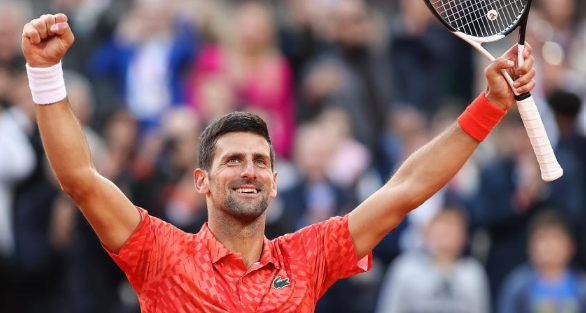
No man in the history of the world had won 23 major singles tennis championships until Djokovic forged the feat on Sunday, beating Casper Ruud in the Roland Garros final. We can argue to the end of time about which man is the GOAT, but if numbers and not conjecture or theory are your thing, Djokovic now owns something Rafael Nadal does not, and it can’t be debated or rationalized.
23 > 22. It’s a cold, plain fact. It might not end the arguments (though for many it will), but it definitely ends one very long battle, one big component of what fans and pundits have discussed in the Big 3 era of men’s tennis.
Rafael Nadal will probably call it a career in 2024. The idea that he can win one major, let alone two, is not removed from the realm of possibility, but it’s unlikely. Roland Garros 2024 is clearly Nadal’s best chance to win a 23rd major, but even if Rafa does that, does anyone seriously think Djokovic won’t win at least one more major? Heck, he’s the clear favorite at Wimbledon and — if his health holds up — will be the favorite at the U.S. Open.
Carlos Alcaraz is a special player, but we all saw how the larger holistic challenge of major-tournament tennis — at least when Djokovic is on the other side of the net — is still something the Spaniard hasn’t figured out. It was easier when Frances Tiafoe was the semifinal opponent at the U.S. Open.
Tiafoe — with all due respect — is no Djokovic.
Nole is in a class by himself, for only he — not Stefanos Tsitsipas, not Jannik Sinner, not anyone else currently on tour (we exclude Nadal because he’s on the shelf for several more months with an injury) — could make Alcaraz that nervous, that tense, that conflicted about how to mentally handle a match and a moment. Alcaraz’s runaway stress and anxiety led to the cramps which not only helped Djokovic win, but win without a five-hour lung-busting marathon on Friday. That gave him more than enough physical renewal and strength for Sunday against Ruud, who tried gamely, but was not in Nole’s weight class as a proven performer.
Djokovic won this French Open the way he has won so many other majors: with his strength, with his fitness, with his clutch serve, with his tennis IQ, with so many different qualities, but ultimately, Djokovic won this tournament by raising his game in the important moments after going through 30- or 45-minute patches in which he wasn’t playing well.
As we herald Djokovic as the greatest men’s tennis player of all time — the point might still be debatable within certain parameters, but we can all agree it’s much harder to argue against it now — that is the foremost reason Nole is now number one on an all-time scale.
His great contemporaries, Nadal and Federer, are legitimately great and legendary in this specific regard, but Djokovic is greater at it: playing well in the precise few moments in which he absolutely has to excel, after a series of moments in which he doesn’t play well. Nadal and Federer could certainly shrug off a bad half-hour to then thrive in a tiebreaker or at 5-5 in a decisive set. They have done so hundreds of times in their careers. Serena Williams is a crunch0-time giant on a similar level. The number of times all of those players have handled difficult matches and difficult periods with resoluteness and inner calm is enormous.
Djokovic, though, has mastered this art to an even greater degree.
No player I have ever seen — and I saw Chris and Martina as a kid, and then watched their matches on YouTube decades later — is better at playing well after 30 minutes of playing poorly than Novak Djokovic. No one recovers better, turns the page better, channels his focus better, in supremely defining tennis moments.
It was and is fitting that Sunday’s bearer of history — major title No. 23 — was achieved primarily by the capture of a first-set tiebreaker after more than an hour of play in which Djokovic was not at his best. The tiebreaker arrived and — much as Djokovic simply did not miss in the tiebreakers he played against Federer in the 2019 Wimbledon final — Nole did not err against Ruud.
The cleanness of his tennis shines, but it’s the context in which the clean tennis emerges — after a period of struggle — which separates Novak Djokovic from everyone else.
I think we can all see that, and yet I’m not sure it is fully appreciated for what it is.
Doing something well every day — month, year, decade — is an achievement.
Djokovic has done this for a full career.
We’re all trying to wrap our minds around it. The enormity of what Nole has done outstrips the limits of the human tongue to fully express what he has forged on a tennis court.
 Tennis with an Accent