
It is noteworthy — and never worth concealing or ignoring — the reality that every Wimbledon, a few players injure themselves to some degree by slipping on the grass of the All-England Club. That’s a problem and a legitimate concern, and anyone who likes grass-court tennis shouldn’t try to sweep it under the rug. This is a legitimate reason why a subsection of fans views grass as an obsolete object of curiosity which shouldn’t maintain a place in tennis. We can put that on the table and acknowledge it.
Then, however, we have to consider at least one of the main reasons for these slips and falls: Tennis players barely spend any time on grass during the year. The notion of a “grass season” is a misnomer, because the whole tennis tour has three weeks to prepare for Wimbledon after Roland Garros. Grass tennis claims five weeks on the calendar, six if one includes Newport, but the top players generally play three weeks of grass tennis per year: one week of warm-up events, then the fortnight at SW19. That’s not a season; that’s a cameo.
It is well worth noting that through 1974, three of the four majors were contested on grass. Through 1987, two of the four were. We could note that the use of wood racquets created a very different style of play which was less conducive to slips and falls. The modern, violent, physical iteration of baseline tennis invites a different dynamic in which changes of direction on a slippery grass surface create more injuries. Yet, if players played three to four months on grass and had at least one 1,000-point tournament on the surface in addition to Wimbledon, it’s reasonable to conclude that players would be more comfortable on the surface and would more fully grasp its nuances.
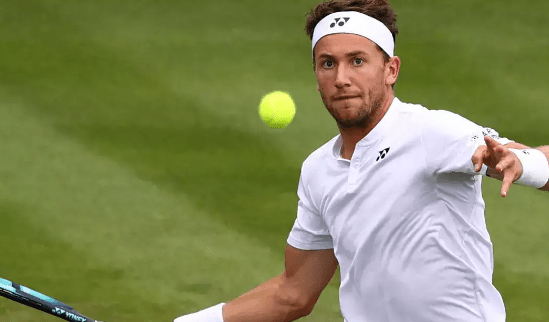
Grass might be the odd, unloved stepchild of tennis, but after a first week of Wimbledon in which Casper Ruud — so competent and self-assured on hardcourts and clay — looked lost in his defeat at the hands of World No. 142 Liam Broady, the value of grass tennis should be seen in a more positive light.
Isn’t it a GOOD thing that players have to adjust to the nuances of different surfaces? As much as tennis is tennis no matter what the surface (a reality reinforced by recent decades of Wimbledons in which baseline tennis has predominated and the chip-and-charge days of a chewed-up court in the 1970s and 1980s are long gone), it also remains that grass does call forth some skills which hardcourts and clay do not.
Look at Grigor Dimitrov and Matteo Berrettini using their carved slices on grass to great effect. Look at Carlos Alcaraz, playing imperfectly but figuring out the surface like any great player should. Look at Ons Jabeur’s variety continue to pay off at SW19.
Isn’t tennis more interesting when the top players have to meet more challenges, not fewer, over the course of a season, and have to make fresh adjustments? It’s not a thunderous indictment of their failures if they don’t make those adjustments. Naomi Osaka will be a Tennis Hall of Famer based on her major titles on hardcourts. Gustavo Kuerten made the Tennis Hall of Fame based on his clay-court prowess. They mastered only one surface but are rightly considered greats of the game with a permanent place in the sport’s history. It doesn’t reflect poorly on them that they didn’t solve grass.
However, the players who were great on clay and grass (Borg), hardcourt and grass (Sampras), and all three surfaces (The Big 3, Graf, Evert, Navratilova, Serena) elevate their reputations precisely because their clay and hardcourt genius carried over to lawn tennis.
Many will say grass is not necessary. In many ways, it is more necessary than ever, even though it claims only a few weeks of every tennis season.
 Tennis with an Accent