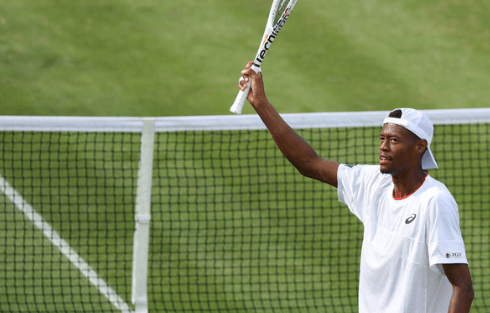

Two big lessons emerged from Chris Eubanks’ victory over Stefanos Tsitsipas in the fourth round of Wimbledon on (not-so-Manic) Monday.
The first lesson applies to Eubanks, whom American tennis fans probably recognize as a guest studio analyst on Tennis Channel earlier this year. Eubanks is a very thoughtful person, highly intelligent and keenly aware of what goes into elite-level tennis. He understands and processes the game at a deeper level. His head knowledge — book smarts — cannot be denied or ignored.
Yet, it’s not the intellect which wins intensely pressure-packed competitions such as the Tsitsipas match. A lot of high-stress activities depend less on brilliant thinking and more on letting the body do what it is supposed to do. The brain is important in pressure-packed moments not when it becomes especially active, but when it gets out of the way and allows the body to flow freely.
Turning the brain off, not on, matters a great deal in many life situations. Overthinking situations, spending too much time wondering what will happen or worrying about the significance of a moment, is exactly how human beings get overpowered by anxiety. Pushing aside the inner commentator — the smart, intelligent student of the game — has to be achieved in those consequential hinge-point occasions soaked in pressure.
There is a time for commentary and self-reflection. 5-4 in the fifth set, down break point, isn’t it.
Chris Eubanks had to walk through that pressure — much as Iga Swiatek had to deal with the stress of not succeeding on grass courts in her win over Belinda Bencic — and focus less on his thoughts, more on playing the next point.
He wasn’t perfect, but he was good enough. After he lost the break lead at 3-2 in the fifth set, he came right back with a confident, aggressive return game to break for 4-3. When he faced subsequent break points and Tsitsipas was within an eyelash of getting back on serve, Eubanks played with clarity amid the chaos and closed the deal. He stopped commentating on the match and resumed playing tennis. That’s what he needed, that’s what he produced.
The second really big lesson from this match is the larger notion of a “safe space” in tennis. Andre Agassi said of Roger Federer early in the Swiss’ career that when he played Federer, there was no safe place for him to go. Federer had so many weapons and resources and could win points in so many ways that Agassi didn’t have one guaranteed “go-to move” which could offer an especially reliable way of winning points versus the Swiss.
This is very true of Rafael Nadal and Novak Djokovic as well. The elites have such well-rounded games and are so psychologically strong that there’s no obvious, reliable path to victory against them. This is why the tours had (and in the case of Djokovic, still have) such a tough time figuring out the right game plan against the Big 3. There is no safe space to go to in a given match.
With Tsitsipas, however, it’s different.
If you’re in trouble against Tsitsipas, what do you do? You serve and hit to the backhand. You demand that Stef hit a backhand return and dare him to hit the ball hard enough and deep enough to create a neutral point.
Eubanks was able to finish this match because — in spite of his extreme stress and nerves late in the fifth set — he had a reliable, bread-and-butter move: Serve to the Tsitsipas backhand return. Stef simply couldn’t get enough weight or heft on any return to bother Eubanks, who was able to hit his serve plus one (the first shot after the serve) into the open forehand corner after Tsitsipas had to move to the ad-court doubles alley to return the serve. Eubanks reliably saved break points with this very simple formula.
Having a safe space helped Eubanks gain the clarity he needed to ultimately win.
The match was one long affirmation of how badly Tsitsipas suffers on grass — and generally — due to his lack of a decent backhand return. If there’s one thing the Greek simply has to improve if he wants to take the next step up the ladder in the men’s game, it’s that.
Eubanks learned about turning the brain off. Tsitsipas learned nothing new, but was brought in touch once more with the damage done by his lack of a backhand return. Two lessons were part of Monday’s most riveting match at The Championships, Wimbledon.
 Tennis with an Accent