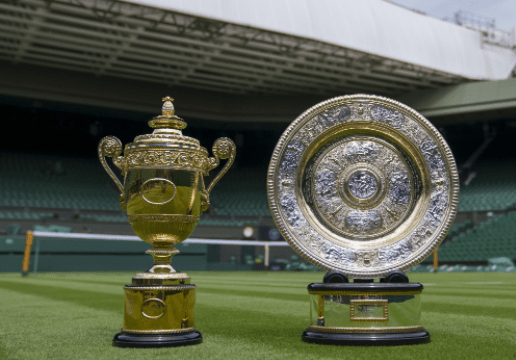

Tennis fans will always debate which tennis tournament is the best or the most important or the most coveted. I’m not here to give you an answer, but I am going to point out how much the top players in the world cared about Wimbledon in 2023.
We saw Ons Jabeur want this title so badly that it slipped through her fingers on Saturday against a deserving and worthy Marketa Vondrousova. Jabeur’s nerve-soaked performance reminded us that one can want something too much. Getting out of the way and just hitting the ball is necessary for tennis players at every level of competition. You can’t spend a match thinking about the meaning of an achievement which hasn’t yet been forged. Play the game, play the ball, and let the trophy case take care of itself.
It all seems so conceptually simple, but that’s why the inner game of tennis and Timothy Gallwey’s seminal 1974 book are so central to success in elite competition. If it was so easy to block out the voices in the head, the inner commentator which is constantly telling us how amazing it would be if we won, and how horrible it would be if we lose, many more great and talented players would win big championships. As we know, it doesn’t always happen that way.
Talented, highly-seeded players did play as though hounded by demons at this Wimbledon, aware of what victory could mean and therefore too eager, too insistent, on winning. The overeagerness of players and the deep hunger for an elusive triumph hijacked their games instead of fueling them.
Jessica Pegula had a point for 5-1 in her quarterfinal against Vondrousova. She hadn’t reached a major semifinal and was so close she could taste it. Vondrousova definitely played well late in that match, but a top-10 player with Pegula’s credentials has to find a way to lock down on serve and carry that match home. It was one of several big pendulum-swing moments in which a run of four or five games marked a great unraveling and dramatically changed the course of this tournament.
Pegula, of course, has never won a major championship. Iga Swiatek has won four major titles. Yet, she was also burdened at this Wimbledon, because this is a tournament she has never won. She has never won the biggest grass-court tournament in the world, and the desire to master grass with a master class burned very deeply inside her. Swiatek played this tournament like a player who wanted to win Wimbledon more than anything.
That’s not a good thing. Wanting to win is different from paying the price needed to win, and making the adjustments necessary to win.
Swiatek rushed through important sequences of matches, most notably the loss against Elina Svitolina in which a 5-3, 30-0 first-set lead turned into a 7-5 set loss and ultimately a match defeat in the quarterfinals. Swiatek, as the World No. 1, should be more willing than anyone else on tour to hit a few extra balls and patiently steer points to her advantage. Everyone else should be going for broke against her, since she has more game than anyone out there. Yet, Swiatek was the player pulling the quick trigger and trying to end points quickly.
Does grass reward first-strike tennis? Sure it does. Being able to execute a first-strike game plan is necessary on the surface … but not all the time. No surface is so unique that a little patience is unnecessary or unimportant. Every tennis player, every tennis match, requires patience. Swiatek’s ravenous appetite for victory and conquest at Wimbledon — being able to say she figured out grass — devoured her dreams instead of aiding them.
Demons loomed large at this event, where hungers weren’t tamed and appetites weren’t channeled or finely calibrated into the larger project of putting a player in the best possible position to succeed.
Much earlier at this tournament, we saw Taylor Fritz and Sebastian Korda crash out of SW19 — Fritz after leading by two sets (6-3, 6-2), Korda after getting extremely nervous in a first-set breaker against Jiri Vesely. Throughout the fortnight, talented players in position to win matches were ambushed not only by their opponents, but by the desire to succeed.
When studying morality, students learn that sin and evil often flow from excesses or malformations of virtues. For example, the desire to bring about justice for everyone, to right wrongs and provide a “Robin Hood” outcome in which the poor get more or the rich get less, is a good and healthy inclination, indeed a virtuous one. We should all have that inclination. Yet, when that good inclination is taken too far, it can manifest in the form of murdering a billionaire or stealing a wallet from an older and clearly wealthy woman in a department store. Having the inclination, the desire, isn’t wrong; the essential point is that the desire has to be channeled, calibrated, and ultimately manifested in healthy ways for it to be a good thing.
So many tennis players at Wimbledon in 2023 cared about winning this tournament and lifting this trophy. That itself is a statement of how much this tournament matters, but the more essential and central point is that raw desire doesn’t translate to a Wimbledon title; taming the inner demons and hungers — thereby allowing the human body to flow freely and do what it was meant to do — is even more important than having the talent needed to play tennis at a high level.
The inner game remains supreme.
 Tennis with an Accent