
By Jane Voigt
Washington D.C. – Fifty-five years ago Donald Dell, John Harris and Arthur Ashe selected Rock Creek Park in Washington D.C. as the home of the Capital Tennis Tradition. Dell, the captain of the U.S. Davis Cup Team at the time, especially wanted his friend Ashe as a partner in the venture. He agreed to the tournament, which is now called, somewhat awkwardly, The Mubadala Citi DC Open, “as long as it was held in a naturally integrated area so all who wished to attend, could and would attend.” Ashe kept his promise, playing in eleven editions and winning it once in 1973.
Fast forward to 2023, the Sunday before the main draws begin here in Rock Creek Park. No longer a minor event on the annual international tennis tour map, it has combined with the Mubadala Silicon Valley Classic sponsored by the Abu Dhabi-based Mubadala Investment Company, allowing an expansion so explosive that’s the tournament is now the first-ever and only combined ATP/WTA 500 level production in the world.
In fact the tournament website calls it “the fifth largest event in the U.S.”
But given the original intent of the event – that promise made by Dell, Harris and Ashe – is this hometown tournament bound to outgrow its modest beginnings? And if expansion continues what about facility upgrades? One obstacle is the U. S. National Park Service, which owns the land. Another is a peaceful urban neighborhood sometimes wary of the 10-day invasion of fans, players, and media.
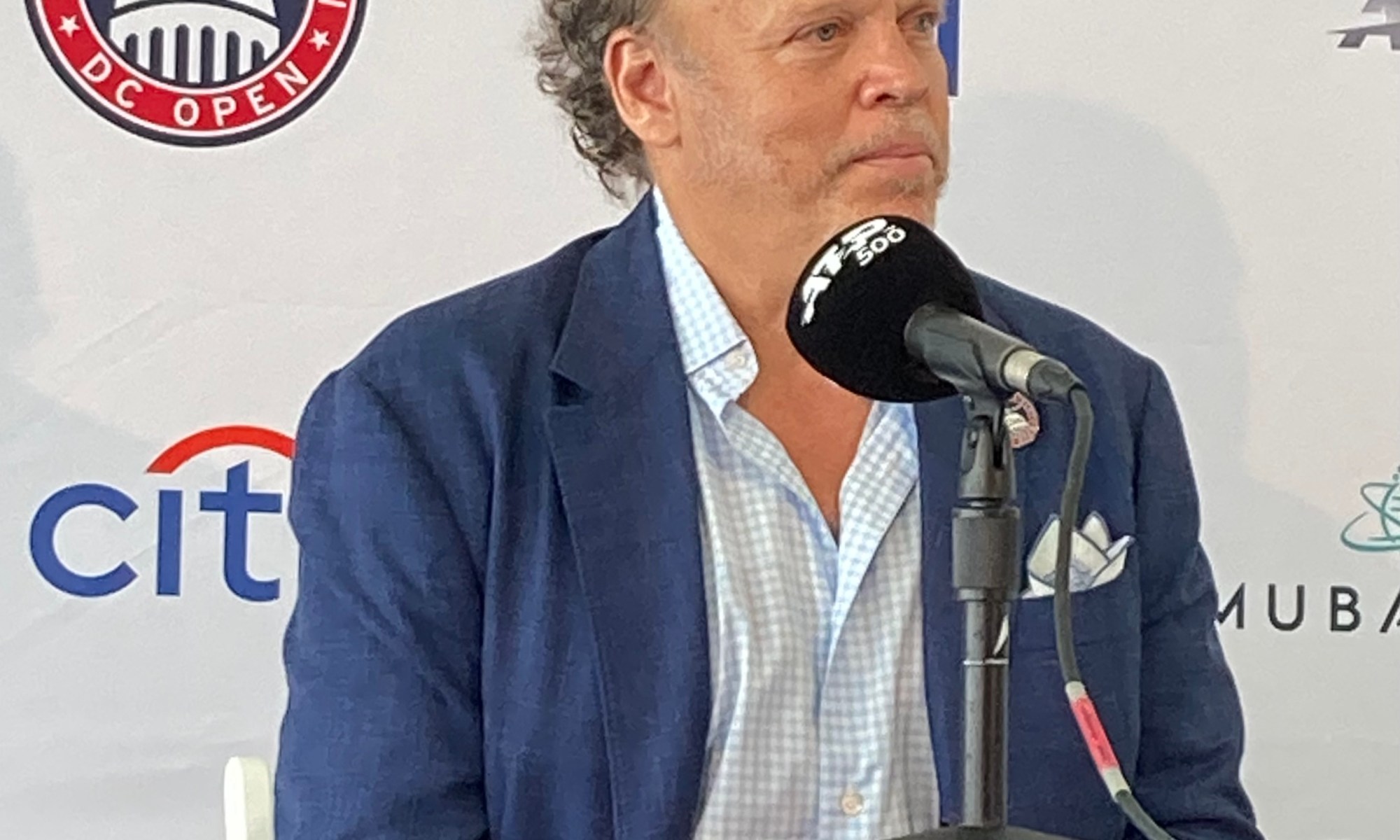
Mark Ein, CEO and owner of MDE Sports & Entertainment, oversees operations for the tournament. A thoughtful person who grew up in a nearby Maryland town, and who originally volunteered as a ball kid here, knows that the future has obstacles. However, his love of the sport and this tournament in particular might be able to overcome obstacles that, to some, seem insurmountable.
“The events sold out every session for the past two years,” he began. “It’s pretty much sold out already for the entire tournament. We are hitting the limits of what we can be here and hopefully we’ll find a solution.”
The U.S. Park Service gives the tournament three weeks prior to the start date to get the site in shape.
“It’s a real issue, to be honest,” Mark added. “The ultimate vision… I’d love to keep it here where Arthur Ashe, Donald Dell and John Harris put it. But if we are going to do that, it definitely needs a bunch of investment. [It] needs some flexibility around some of the rules. We are at capacity. Nonetheless, the park service and the city have been talked about growth for a long time. They know there’s a better solution [by] bringing all the stakeholders together. Those conversations are further along than ever before.”
Ein admitted that the biggest problem the tournament faces is parking.
“It’s a difficult problem,” he said. “We know it’s important to our fans. We are trying to figure out a solution with the Park Service and with the city and with the neighborhood. It’s a big challenge that long term we need to solve. I feel horrible about it, but it’s really hard to solve. I’m sorry about that.”
The tournament’s being promoted as a win-win for both men and women players, and for the sport. But that’s not entirely true. The man and woman who win their respective singles draw will be awarded 470 points each, meaning equal points for their rankings. However their prize money won’t reach the equanimity as marketed. The men’s purse will be $353,000; whereas, the women’s champion will pocket one-third that amount: $120,000.
“I’m totally behind equal prize money,” Andy Murray said, during the tournament’s media day interviews Sunday. “I think it is difficult for it ever to become truly equal until the ATP and WTA combine and work together. But I always felt when we’re competing at the same event on the same courts that we should be playing for the same prize money.”
“The stand-alone events have to have equal prize money for the same category,” Mark said, when speaking about the differing levels of competition. For example 250, 500 and 1,000 levels. “The combined events, of which we are the only one, have to do it by 2027. So by ’27 it will be the same.”
Growth in international sports never takes an upward, smooth trajectory. It’s a competition in an of itself.
“Obviously they are trying to do more and more with the event and get it better and better,” Frances Tiafoe, No. 2 seed and Hyattsville, Maryland, native, said in press. “Ultimately, you want these kids to be near. You want these kids to be as close to great tennis as possible. I think Mark’s going to do everything in his power to keep the tournament here and keep it accessible to everybody. I used to sneak in to this event. Same security guards that were back then are here; and, we still laugh about it. That’s the event. I’m going to fight for that. That one kid could be me one day. Why not?”
Donald Dell and John Harris, in 1972, “decided to transfer the [tournament] sanction and date on the American tennis calendar to The Washington Tennis & Education Foundation [WTEF].” Although MDE Sports & Entertainment took over the tournament in April, 2019, the WTEF remains the beneficiary of the event as a non-profit organization that “provides after-school educational and tennis programming to DC’s underserved kids.” Throughout the week the Mubadala Citi DC Open will feature programs developed by the WTEF, which, in fact sustains the vision born by Dell, Harris and Ashe.
If all entities molding the future of this event stay on track, tradition could prevail and the Capital Tennis Tradition could live on. However, the economics of international sport production could have another story to tell no matter the tradition.
 Tennis with an Accent