
By Jane Voigt
I will miss John Isner. Not because of his game style, which I really never enjoyed, but because he was the player I wrote about first. He was the man who came in from the cold and captivated the nation’s capitol in July 2007, at the then Legg Mason Tennis Classic, currently billed as the Mubdala Citi D.C. Open.
Isner had just graduated from the University of Georgia, a two-time NCAA champion in doubles, and joined the main draw in D.C. as a wild card. Now, 17 years later, he says he will retire from the game with no regrets.
My thoughts go back to the first time I saw him on opening Monday, arriving at the Rock Creek Tennis Center early to watch practice. There was some unnamed giant of a man serving lights out on a side court, with two kids peering through the chain-link fence.
“Do you know who that is?”, I asked them.
“Yeah,” they said. “That’s John Isner. A Georgia bulldog.” Certainly I had much to learn and realized knowledge could come from people in the know that weren’t tennis pundits or members of the blogosphere, which was in its infancy.
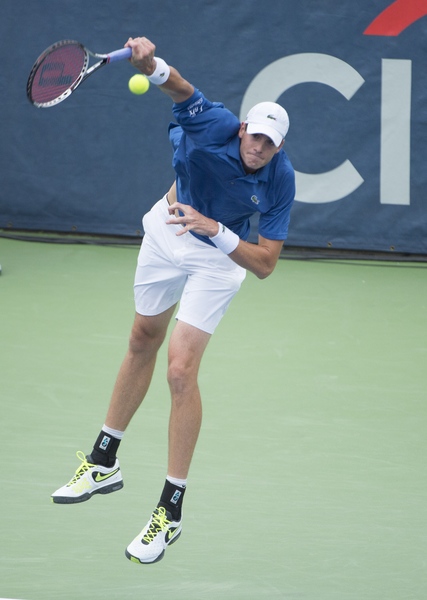
Isner cracked serves at amazing speeds, the apex of his Prince racquet hoop coming mighty close to the lower-hanging crepe myrtle blossoms that framed the site, turning the atmosphere into a garden sport.
That night Isner played his first-round match against Tim Henman. The match was featured on Stadium Court, Henman being a huge name at the time: an endearing, popular Brit who had solidified his career with a record four semifinals at Wimbledon, having never gotten to a final, in the late 1990s and early 2000s. Nonetheless, his serve-and-volley game echoed throughout the match, which he lost in three sets to Isner… a tiebreak in third: 4-6, 6-4, 7-6(6).
That pattern repeated itself through the rest of the week, to the thrills of an ever-increasing fan population. If you wanted to know where Isner was playing, just listen… there he was.
Each round “Wildcard Isner” served and fore-handed his way through the draw. Benjamin Becker, seeded No. 8, fell: 3-6, 7-5, 7-6(6). American Wayne Odesnik went down next: 6-7(4), 7-6(3), 7-6(2).
In the quarterfinals, Isner and screaming fans now in from all up-and-down the east coast, mainly North Carolina, waved goodbye to the No. 2 seed, Tommy Haas: 6-4, 6-7(6), 7-6(5).
The ultimate tennis entertainer and supreme athlete Gael Monfils (No. 9) stood face-to-face with Isner in the semifinals. The Frenchman, 21 at the time, pulled out every trick in his repertoire, but couldn’t combat the one asset Isner will forever be remember: his serve. Isner triumphed in another third-set tiebreak.
Sunday of that week was brutally hot with high humidity, a mainstay of life at this time of year in Washington, D.C. Isner would have to bring his best to knock off top-seeded Andy Roddick. A tall order, no matter who he crossed paths with in the previous rounds.
The week’s toil had taken a toll on the Georgia Bulldog; Roddick was not going to acquiesce to this lanky, 6’10” kid who’d never played a tour tournament in his life. No three-setter this Sunday. Roddick raised the hardware after a 6-4, 7-6(4) victory. God bless that last-set tiebreak. Tradition was preserved.
My initial story ran in an online blog for Tennis Magazine. I emailed it to Peter Bodo, who had agreed to my foray into blogging. He ran the story, but not before he contacted Greg Sharko, the recently retired 37-year ‘stats guru’ for the ATP, asking just who was this Isner anyway.
No one asked again. Isner imprinted himself on the nation’s tennis populace and ran with it for the next 17 years. He leaves the game with no regrets and 16 career titles with prize money just under $23 million, according to the ATP. He is married with a family of four, which he cherishes. And, most importantly, he departs on the top of the leaderboard in aces: 14,411, having won 79% of his first-serve points. No player had ever accumulated that number of aces.
 Tennis with an Accent