
Sharada Iyer — Tennis With An Accent
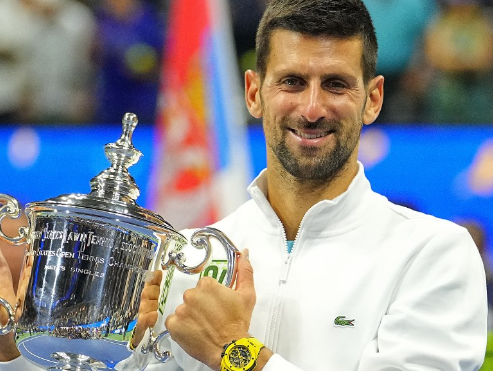
At the end of the second Sunday at Flushing Meadows, proverbially speaking, Novak Djokovic was the last man standing. Both literally and figuratively. In that context, he is also the only man standing as far as numbers are concerned, after having won his 24th Grand Slam title. To give more numerical heft to this, it has taken only 15 years for Djokovic to get here. But not all these years have been easy to get through for the Serbian, which adds to the substantialness of his achievement.
Back in 2016 after Djokovic had completed the career Slam at Roland Garros, the trajectory of his dominance veered from the path he had taken, fueled by a 2015 season which rates among the greatest in tennis history.
He turned up at Wimbledon as the defending champion but didn’t play like the possessed player who brushed past Roger Federer the year before. Djokovic got through the first two rounds but exited in the third after being convincingly outplayed by Sam Querrey. Later that year, he also reached the US Open final, but in Stan Wawrinka he encountered a fearless and audacious nemesis who blocked his road at a Major for the third straight year.
If these were the signs of a man whose tennis-worldly instincts had faded, 2017 was a period of further upheaval for Djokovic. Dennis Istomin, the unlikeliest of names, upset him in the second round of the Australian Open. Djokovic’s loss in the second round can perhaps be considered the second-biggest surprise of that 2017 tournament, second to Roger Federer finally figuring how to best Rafael Nadal at a major for the first time since in 10 years, since Wimbledon 2007.
As the 2017 season progressed, Djokovic reached the quarterfinals of both the French Open and Wimbledon. However, these results were akin to applying plasters on a significant injury, given how disenchanted and disoriented he looked on the court. Djokovic’s tame defeat to Dominic Thiem in Paris – in which the Austrian bageled him in the third set – only added to his woes.
Djokovic was injured, which explains his struggles to a certain extent. However, Djokovic did legitimately wander through the forests of uncertainty. His search for restoration led to decisions which were perplexing. These included calling time on his coaching collaboration with Boris Becker at the end of 2016, and also bringing in player-turned-holistic-advisor Pepe Imaz to mentor him. In 2017, ahead of the French Open, Djokovic also turned to Andre Agassi for guidance.
Djokovic continued to struggle, both with his inability to stitch results the way he wanted to and in his quest to find peace with his game. His absolute loss of form prompted some painful admissions in his post-match press conferences.
Among these, the most notable statements emerged after his 2017 loss to Thiem at Roland Garros. He said, “I’m trying, as everyone else, to work on the game, and, you know, work on things. Sometimes it works; sometimes it doesn’t. For me, it’s a whole new situation that I’m facing, you know, especially in the last seven, eight months, you know, not winning any tournament, which hasn’t happened in many years. So, you know, it’s not something that hasn’t happened before for any player. You know, all the top players have been through that. So, I guess you’ve got to go through it, try to, you know, learn your lessons and figure out the way, how to get out of it stronger.”
There was one other line he added: “It’s a big challenge, but I’m up for it.”
From then until now, in these six years, Djokovic has done exactly that. He’s tamed his on-court rivals just as he has continued to keep his personal demons at bay. And he’s done so on his own.
The 29-year-old and 30-year-old Djokovic found solutions to problems not of his making. In the present, the 36-year-old Djokovic seems to be working with the certainty that regardless of its origins, only he is capable of resolving his issues.
In consistently doing so, the Belgrade native has pushed himself so far high up the ladder that it takes near-superhuman effort from his opponents to even come close to him in a match. Intermittent as these results are, Djokovic’s continued triumphs also seem to have made him indefatigable. At times, when he speaks, these successes suggest the appearance of someone who is not tethered to the bounds of realism and the changes created by time.
However, when one takes a closer look at his words, Djokovic’s speeches are rooted in reality, and more precisely, the reality of uncertainty.
“There’s always something that I’m trying to add so that I can up my performance in my game, you know, at least for a few percent. It’s a constant process of trying to get better and trying to implement certain things that work for you and finding that formula. When you find it, you know, the biggest I feel like, one of the biggest lessons I have learned probably mentally throughout my career is that, you know, even if you find a formula that works, it’s not a guarantee, and actually most likely it’s not going to work the next year,” Djokovic said, after his win over Medvedev in New York City.
“You need to reinvent yourself, because everyone else does. As a 36-year-old competing with 20-year-olds I probably have to do it more than I have ever done it in order to keep my body in shape, in order to be able to recover so that I can perform on the highest level consistently. Also, mentally and emotionally to still keep the right balance between motivation so that I’m actually inspired and motivated to play the best tennis and to compete with these guys and to actually not let go in the moments when I maybe can, and at the same time keep the playfulness and passion for the sport.”
A decade-and-a-half after he began his journey as a showman in the Slams, this epiphany is the most potent transition of Novak Djokovic. From this point on, if he still wants to go forward and keep adding conquests to his already tall pile, there’s no reason to decry his aspirations. Perhaps he’s being selfish, but that’s what it takes to be the best in the world – to want something so passionately that the rest of the world can only marvel at one’s continued elite tennis and supreme excellence at a craft.
 Tennis with an Accent