
By Sharada Iyer, Tennis With An Accent
Among the many upsets that have dotted the courts at the 2024 Australian Open, one was Alexander ‘Sascha’ Bublik’s loss. Seeded 31st, the Kazakh came to Melbourne Park after reaching the semifinals in Adelaide. He had momentum and reason to believe he could make a run Down Under.
His opponent made the main draw of this tournament as a qualifier. Seeded player versus qualifier? We know who is supposed to win that one.
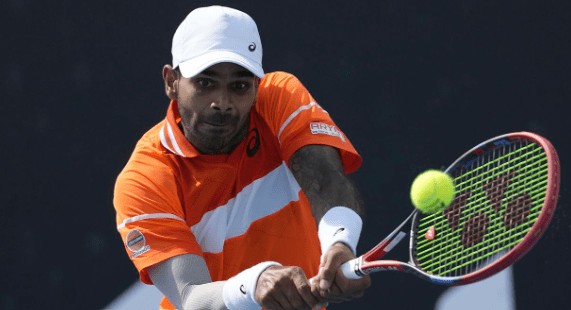
Sumit Nagal had other ideas.
Since the 137th-ranked Indian scripted Bublik’s straight-set exit from Australia, we have been reacquainted with his struggles on the tour. These struggles pertained to his fitness and form as much as his finances. Somewhere, though, the dichotomy between the two continued to widen even as Nagal did his best to bridge these differences.
Throughout 2023, Nagal – whose ranking had dipped outside the top 500 at the end of 2022 due to injuries – spent his time trying to rack up consistent results on the Challenger Tour. He propped himself up in the rankings and ended the season ranked well-inside the top 150. Nagal finished with two ATP Challenger titles (Rome and Tampere) and as the runner-up in two others (Tulln and Helsinki).
Notching these numbers didn’t add much to his wallet or lead him to even think beyond the short-term in the sport. However, the extent of how dire his straits were only came to light after the 26-year-old spoke about it this past September.
“If I look at my bank balance, I have what I had at the beginning of the year. It is 900 euros,” he said, describing the meagre support he’d been getting to keep him going on the Tour. “I don’t have anything in savings. I am just breaking even. I cannot say I live a very good life or where I say I don’t need to work. I did not earn anything in the last two years so I am happy that I am breaking even.”
The prize money Nagal will now get after his first-round upset offers a hefty boost to his prospects. It’s as though for the first time Nagal has managed to bring out the best in himself while not just subsisting on whatever bread crumbs he could get.
There’s also a certain irony and bittersweet quality to how it has all come about for him.
Prior to Nagal’s participation at the Australian Open, he faced a snub. The Indian tennis body – the All India Tennis Association (AITA) – refused to nominate him as a wild card entrant for the major tournament. If the AITA’s disinterest in nominating its highest-ranked singles player was an insult, the rationale cited for its decision made it worse.
According to the AITA’s general secretary, Anil Dhupar, Nagal wasn’t nominated because he refused to play the upcoming India-Pakistan Davis Cup World Group I tie in February. The Hindustan Times quoted Mr. Dhupar as saying, “One cannot expect to pull out of a Davis Cup assignment for the country and then expect something in return from the federation. Why should we send anything from our end to nominate him? AITA had to take a stand against such things at some point.”
Nagal’s rise in the rankings made it possible that he would get to play the qualifiers in Melbourne, but the AITA set a dubious precedent that can never be overlooked. Moreover, for a country whose tennis prospects have continued to wane over the years, the tennis “system” in the country – as it’s called in the Indian parlance – has also been caught at a time when Nagal is poised to crack a new career-high ranking, much closer to the top-100 than his previous best (122).
When speaking after his win over Bublik, Nagal offered his thoughts on changing this “system.”
When asked by an interviewer what he thought needed to change in India, Nagal said, “A lot of things. First to have more tournaments in the country, bring coaches in, better facilities. Just a better system, I would say. Why are all tennis players – singles, I’m talking about – going outside India and living outside India to give themselves a chance? We should ask why. Like I said, of course, we can sit here all day and talk about it. But in a simple word I will just say it’s (changing) the system. That’s it.”
In any of the previous years, these words of India’s No. 1 player would’ve been seen as being alarmist. However, in the year when the country is no longer hosting any ATP main tour event – the lone ATP event it had held since 1998 was shifted to Hong Kong in 2024 – these words seem to signal desperation.
Granted there are ATP and WTA Challenger events held in the subcontinent. There are also plenty of ITF events that take place in the nation. Yet, players wanting to have a home tournament by way of support and acknowledgement from the “system” have been left wanting. It’s as though there’s no incentive to help them keep pushing through from where it ought to come, first and foremost.
Hopefully, Sumit Nagal’s Australian Open euphoria will bolster the morale of young Indian tennis players. Most of all, hopefully, Nagal’s results won’t just be remembered through the pages of history, after 35 odd years – like Ramesh Krishnan’s first-round victory over Mats Wilander at the 1989 Australian Open is being recollected now.
Hopefully, Sumit Nagal’s achievements and his public message will lead to necessary reforms in Indian tennis governance.
 Tennis with an Accent