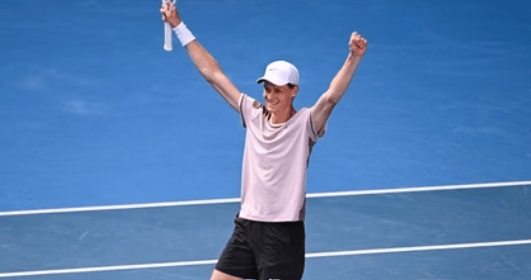

Jannik Sinner’s loss to Novak Djokovic at Wimbledon in 2022 was the kind of moment a young tennis player almost invariably encounters. Bjorn Borg and Rafael Nadal learned how to win at an elite level at a very young age, but they are the exceptions, not the rule. Most tennis players — most human beings — have to learn how to fail and absorb the lessons from failures before they become really good at a given profession or craft. Sinner was thrown into the deep end of the pool in that match against Djokovic. He had to taste the bitter herbs of nearly — but not quite — beating Djokovic on the big stage of Wimbledon.
Young athletes in any sport — not just tennis — have to be honest with themselves when they absorb crushing losses against great opponents in significant meetings. They have to be absolutely clear about why they lost and what they need to do better, but they also need to be patient enough to realize they might not immediately find the winning formula. They need to realize why they lost, without being torn up by frustration.
Jannik Sinner has clearly shown that he learned from Wimbledon in 2022.
Sinner spoke after his victory over Novak Djokovic about the end of the third set, when he had match point and was almost home, but missed a few shots and allowed a determined, improving Djokovic to win the set and prolong the match. Sinner told Jim Courier, “That’s tennis.” There was a matter-of-fact acceptance that the margins were small, and that focusing on the fourth set was the only thing he could do after letting the third set slip away. Sinner’s fourth-set performance, steady and solid and marked by an early break of serve which held up for the duration, manifested the tunnel-vision focus he brought to the court.
Given that Sinner did not allow a single break-point chance to Djokovic in the first three sets, merely allowing one break point in the fourth could have felt like the end of the world for him, a mental avalanche which could have overwhelmed him. Sinner never allowed that break point, including on that telltale 3-1 service game in the fourth right after breaking Djokovic’s serve. Sinner stayed in the moment and didn’t allow situations to snowball. One sign of his lucidity was Sinner’s ability to hit the first shot after his serve with conviction and purpose. The first shot after the serve — “the return of the return” — regularly put Sinner in a winning position. That revealed a readiness to hit the next ball.
Sinner wasn’t hoping to win. He was working to win. He was doing the things needed to put himself in position to win. It’s exactly what a player must do when going up two sets on a player of Novak Djokovic’s caliber. If Sinner remained consistent, Djokovic’s comeback — which notched one set — was unlikely to materialize. Sure enough, Sinner never gave away enough points to allow Djokovic a path to victory. With Djokovic not playing or feeling his best, Sinner was going to need to help Djokovic win.
The Italian never gave Djokovic that help. That’s how a comeback from two sets down gets stopped and smothered. Jannik Sinner focused on his tennis, kept his emotions at bay, and played with a clear mind. He showed a level of wisdom many older players lack.
Now he’s in a first major final. We will see if the lessons learned against Djokovic carry over, or if the newness of the occasion creates a painful experience.
If the latter scenario emerges, at least say this: Jannik Sinner is likely to learn from it in the future. He definitely took the right lessons from the past against Novak Djokovic.
 Tennis with an Accent