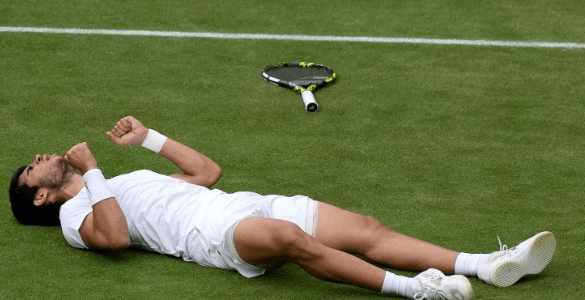

Carlos Alcaraz had played Novak Djokovic before, but not on grass. Not in a Wimbledon final. Not in a major final. The way sports normally work, elite athletes have to lose at least once or twice to the great champions before they learn everything there is to know about that particular challenge and how to meet it.
It’s not just about hitting the backhand in the right moment, or mixing speeds and placements. It’s about doing all of that on a specific surface, against a specific opponent, within specific conditions. How Djokovic’s shots act at Wimbledon is different from how they act at Roland Garros. Getting the full Djokovic experience on a new surface is a challenge of tennis physics. Hitting with the right mix of control and spin is a hefty lift for anyone.
Then add the pressure of a Wimbledon final, a stage Djokovic has fully mastered. Djokovic hadn’t lost a Wimbledon final — or on Centre Court in any circumstance — since 2013. Djokovic is also the great tiebreak king of tennis history, snatching Wimbledon titles from Rafael Nadal in 2018 and from Roger Federer in 2014 and 2019 because of his unmatched ability to win the handful of points which matter most. Djokovic asks so many questions of his opponents and forces them to overcome so many situational and mental hurdles.
Each break point chance lost, each 30-30 game not taken, each deuce game not won, invites a player to mentally crumble. Djokovic occupies more and more mental real estate, and in a blink, Nole has captured another major title. He’s done it 23 times, 7 at Wimbledon.
Playing this guy, this champion, on Centre Court in a Wimbledon final for the first time? We know how this usually works. We know how the story usually ends — even for legendary champions such as Federer and Nadal, who have both tasted defeat against Djokovic on that fabled piece of English lawn in that precise situation.
A 20-year, 2-month-old tennis player — even one as gifted and intelligent as Carlos Alcaraz obviously is — is not supposed to get it right on the first try.
Rafael Nadal needed three bites at the apple to beat Federer in a Wimbledon final.
John McEnroe lost to Bjorn Borg in a Wimbledon final before he beat him.
It is the law of the jungle in all sports, not just tennis. Most of the time, conspicuous youth needs at least one failure before triumphing over a titanic champion and standard-bearer.
Then stop and consider the added details of this Wimbledon final as it played out:
Djokovic, the King of Centre Court, won the first set, 6-1. He led the second-set tiebreaker, 3-0. He had a point for a two-set lead.
The second set of this match lasted over 80 minutes, the third set roughly one hour even though it was only a 6-1 set due to a 26-minute fifth game (at 3-1). Most of the games in this match at least went to 30. There were very few love holds and also few holds at 15. A match with two 6-1 sets nevertheless lasted 4:42. A match with 46 total games (one of them a tiebreak) involved 334 points, for an average of 7.3 points per game. On average, each game was going deeper than deuce.
The match went into a fifth set, Djokovic’s castle.
Djokovic had a break point in the fifth set. He won Wimbledon in 2014 after saving break point in the fifth against Federer. He won Wimbledon in 2019 after his match-point saves against Federer.
Djokovic, the man who has walked the high wire of tennis tension so many different times it’s impossible to count, had Alcaraz on the ropes at 1-0 and 30-40 on Alcaraz’s serve.
After all those deuce games, after all those sets, all those ups and downs, all those peaks and valleys, Djokovic was back where he belonged and where he has so constantly thrived and prevailed — for a decade at Wimbledon, for the past five years at every important tennis tournament in the world (since the beginning of his third elite period in 2018, following the injuries of 2016 and 2017).
In that moment, how many people imagined Carlos Alcaraz could respond? It’s not how it usually works in sports.
Alcaraz is no usual tennis player. He calls to mind what golf icon Bobby Jones once said of a rising young star named Jack Nicklaus many decades ago: “He plays a game with which I am not familiar.”
The fact that Alcaraz won this match isn’t the stunning part. Alcaraz could have had all the shots working and could have had everything clicking just right. He’s that good. He’s so special that he could have caught fire and simply had a great day at the office … but this wasn’t that kind of match.
Alcaraz got punched in the mouth in set one. He was up against it in set two and that tiebreak. He was down a break in the fifth. He had literally never been in this situation before — against Djokovic in a major final at Wimbledon on grass.
You’re not supposed to know how to handle that kind of moment.
Alcaraz did. Moreover, not only did Alcaraz stay the course, he produced two shots of outrageous quality in his final service game — a remarkable drop-and-lob combo on one point and an ARE YOU KIDDING stretch volley on another — to fend off the last Djokovic push.
The skill is what everyone will remember, and rightly so, but it’s the toughness and poise underneath the clutch shots which are truly astonishing, and will remain so for as long as we talk about this match …
which will be a very long time.
This match will last for many years in the public memory of all who saw it. Carlos Alcaraz hasn’t lived on this earth for many years — 16 fewer than Djokovic — but he played like someone who has been accustomed to this setting and wears it like a glove.
That was an extraordinary thing to behold on Centre Court on another memorable championship Sunday at The All-England Club.
 Tennis with an Accent
I haven’t seen the stats yet, but it seemed that Novak did not serve well enough… his worst serving of the tournament. That made a big difference in the outcome.
LikeLike